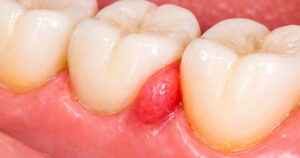
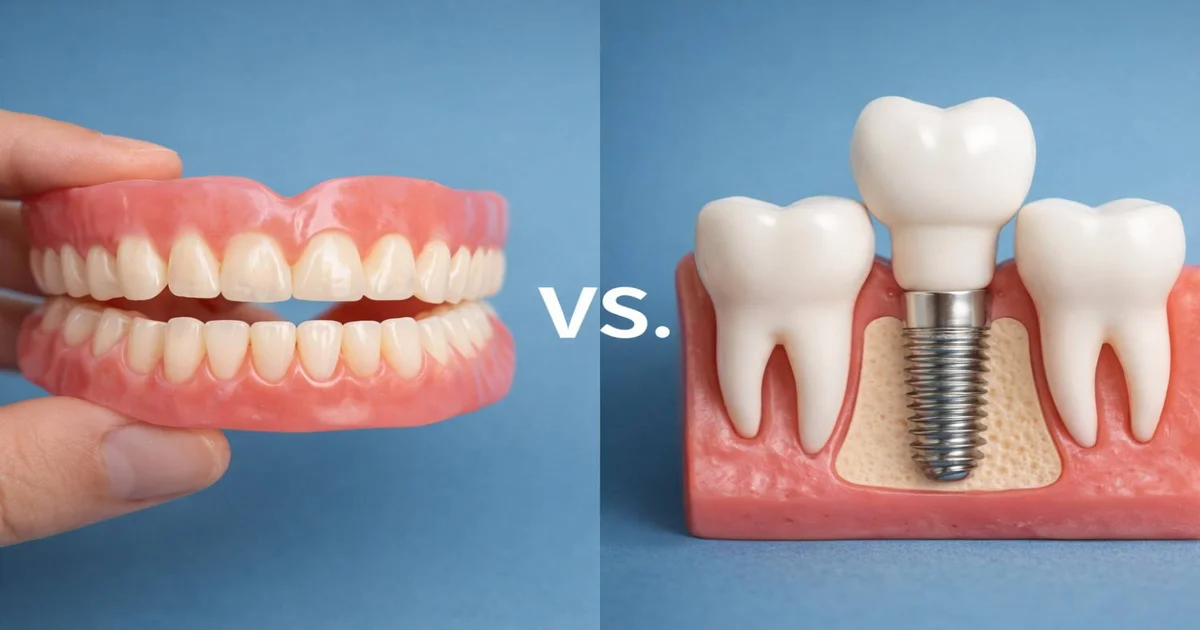

In most cases, dental implants usually cost more upfront, but they can be a better long-term investment for patients with sufficient bone support who want greater chewing stability. Dentures are usually more affordable upfront and may be the right choice for patients who want a removable option or cannot have dental implants because of health, bone, or financial factors.
The real comparison is not only the price. You also need to compare comfort, maintenance, bone changes, replacement needs, insurance limits, and how the option will work in daily life. We’ll help you with this in this guide.
Dental Implants vs Dentures in Toronto
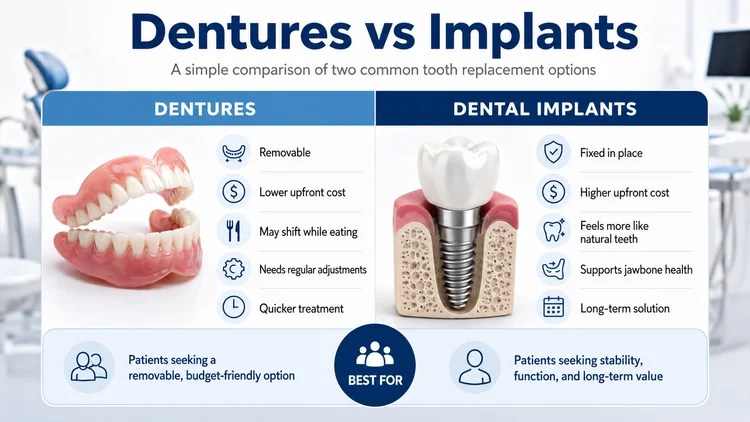
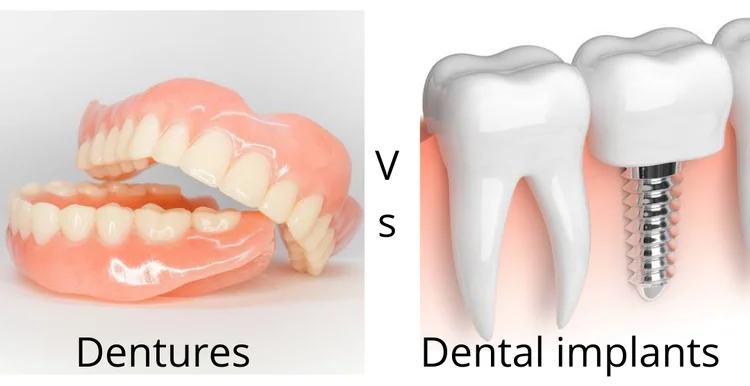
Dental implants and dentures both replace missing teeth, but they work in very different ways. An implant is fixed in the jawbone and supports a crown, bridge, or denture. A denture sits on the gums and is removed for cleaning.
| Factor | Dental implants | Dentures |
|---|---|---|
| Stability | Fixed or implant-supported | Removable |
| Chewing | Usually stronger | Can move during eating |
| Bone support | Helps preserve bone around the implant area | Does not stimulate the jawbone like an implant |
| Upfront cost | Higher | Lower |
| Maintenance | Brush, floss, dental visits | Daily removal, cleaning, relining, or repairs |
| Coverage | Often limited or excluded | More likely to have some coverage |
For many Toronto patients, the best answer depends on how many teeth are missing. One missing tooth may be best replaced with an implant, bridge, or partial denture. A full arch of missing teeth may require full dentures, implant-supported dentures, or fixed full-arch implant treatment.

Book Your Consultation Now
How dental implants work
A dental implant is a small post placed in the jawbone during oral surgery. After healing, an abutment is attached to the implant, and a crown, bridge, or denture is connected to it.
The implant does not replace the visible tooth by itself. It replaces the tooth root. The final restoration is what restores the visible tooth or group of teeth.
How dentures work
Dentures are removable appliances that replace missing teeth. A full denture replaces all teeth in an upper or lower arch. A partial denture replaces some missing teeth while the remaining natural teeth help with support.
A denture can restore appearance and basic chewing, but it may need adjustments as the gums and bone change. Full lower dentures can be harder to stabilize because the lower jaw has less surface area and the tongue can move the denture during speech or eating.
Which option lasts longer
Dental implants can last many years and sometimes decades with good oral hygiene, stable health, and regular dental care. The crown, bridge, or denture attached to implants may need repair or replacement before the implant itself.
Dentures usually need more maintenance over time. The mouth changes after teeth are removed, so dentures may need relines, repairs, or replacement to keep the fit acceptable. Many patients replace dentures after several years, especially if the fit and bite have changed. According to the Healthline website, implants are more expensive, but they could provide 20 or more years of service. On the other hand, dentures are more affordable, but they may require occasional adjustments or replacements through the years.
Which Option Costs More Upfront?
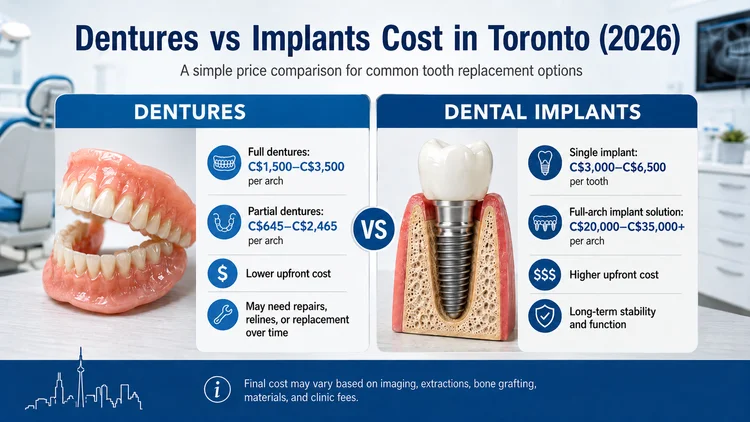
Dentures usually cost less upfront than dental implants. Current Toronto denture pricing pages commonly place conventional full dentures around the low thousands, while local implant pages often place a complete single-tooth implant around $3,000 to $6,500 when the implant, abutment, and crown are included.
The gap becomes larger for full-arch implant treatment. Full-mouth or full-arch implant options can cost much more because they involve multiple implants, surgical planning, temporary teeth, final prosthetics, and lab work. Dentures usually remain the lower-cost starting option, especially for patients replacing many teeth at once.
That does not automatically make dentures the better financial choice. A lower starting fee may come with future relines, repairs, adhesives, replacement dentures, and diet limitations. Implants cost more at the start, but they may reduce some of those ongoing problems for suitable candidates.
Which Option Is Better for Comfort and Eating?
Dental implants usually provide better chewing stability because they are anchored to the jawbone. A single implant crown feels more like a fixed tooth than a removable appliance. Implant-supported dentures can also improve stability for patients who struggle with loose full dentures.
Dentures can work well, especially when they fit properly and the patient adapts to them. Still, removable dentures may shift during eating or speaking. Some patients avoid harder or stickier foods because the denture does not feel stable enough.
Comfort also depends on the fit. A well-made denture can be comfortable, but sore spots can occur, especially after extractions or changes in the gum and bone. Implant treatment has a surgical phase, so comfort must be judged over the full treatment timeline, not only the final result.
How Maintenance and Replacement Costs Compare
Dental implants need daily cleaning, flossing tools, and regular dental visits. They are not immune to problems. Gum inflammation, smoking, uncontrolled diabetes, heavy bite forces, or poor cleaning can increase the risk of implant complications.
Dentures require a different routine. They need to be removed, cleaned daily, and checked when the fit changes. A loose denture can rub the gums, affect chewing, and create sore areas. Relines and repairs may be needed as the mouth changes.
Over time, denture maintenance can add up. Implant restorations can also need repairs, screw access maintenance, replacement crowns, or prosthetic updates. The difference is that implants are designed to support fixed or more stable replacement teeth, while dentures are designed as removable appliances that rely on the gums and remaining oral structures.
Missing Teeth and Still Comparing?
Contact Danforth Dentistry in Toronto to book a consultation and review which replacement option fits your oral health, budget, and daily needs.
Does Insurance or CDCP Cover Implants or Dentures?
Private dental insurance varies by plan. Dentures are more commonly covered as major dental work, often with limits, waiting periods, or partial reimbursement. Dental implants may be excluded or covered only in part. A pre-treatment estimate is the safest way to confirm what the plan will pay.
CDCP coverage is different. The Government of Canada lists removable prosthodontic services under CDCP coverage, which can include complete and partial dentures when the patient meets program rules and service requirements.
CDCP does not cover dental implants in 2026. The 2026 CDCP Dental Benefits Guide lists implants and implant-related procedures as exclusions, including implant-supported restorations and bone grafts.
This means a patient may receive help for some removable denture services through CDCP, but should not expect CDCP to pay for implant posts, implant-supported dentures, implant crowns, or implant-related bone grafting.
Who Is a Better Candidate for Each Option?
A better implant candidate usually has healthy gums, enough bone support, controlled medical conditions, and a willingness to maintain careful home care. Implants may be preferred for patients who want stronger chewing, fixed teeth, or better denture stability.
A better denture candidate may want a lower upfront cost, need a non-surgical option, or have medical or bone conditions that make implant treatment less suitable. Dentures may also be useful as a temporary option after extractions before a final plan is made.
Patients should discuss these points before deciding:
- Number of missing teeth
- Bone level and gum health
- Medical history and smoking status
- Comfort with surgery
- Budget and insurance coverage
- Need for fixed teeth compared with a removable appliance
- Future maintenance and replacement costs
Some patients benefit from a middle option: implant-supported dentures. This uses implants to help stabilize a denture, often improving comfort and chewing compared with a regular removable denture. It still counts as implant-related treatment, so CDCP exclusion rules apply.
Conclusion
Dentures are usually the cheaper short-term option in Toronto, especially for patients replacing several missing teeth. Dental implants cost more upfront, but they often provide stronger chewing support, better stability, and better bone preservation for suitable patients.
Danforth Dentistry can assess your missing teeth, bone support, gum health, and treatment options before you decide between implants and dentures. The clinic can also review insurance questions, CDCP limits, and practical cost differences based on your case.
Book Your Consultation Now
FAQ
These FAQs answer common questions Toronto patients ask when comparing implants and dentures.
-
Are dental implants better than dentures?
Dental implants are often better for stability, chewing, and bone support. Dentures may be better for patients who need a lower-cost or non-surgical option.
-
Are dentures cheaper than implants in Toronto?
Yes. Dentures usually cost less upfront than implants. Implants may cost more at the start but can offer better stability and fewer removable-appliance concerns.
-
Does CDCP cover dentures or dental implants?
CDCP may cover some removable denture services when program rules are met. CDCP does not cover dental implants, implant-supported dentures, bone grafts, or implant-related procedures in 2026.
-
How long do dentures last compared with implants?
Implants can last many years with proper care, although the crown or prosthesis may need replacement. Dentures usually need relines, repairs, or replacement as the mouth changes.
-
Are implant-supported dentures a good middle option?
Yes, for some patients. Implant-supported dentures can be more stable than regular dentures, but they still involve implant treatment and are not covered by CDCP in 2026.